Terry Conrad: Found Resonance
Fall 2025 Artist-in-Residence at Flathead Lake Bio Station
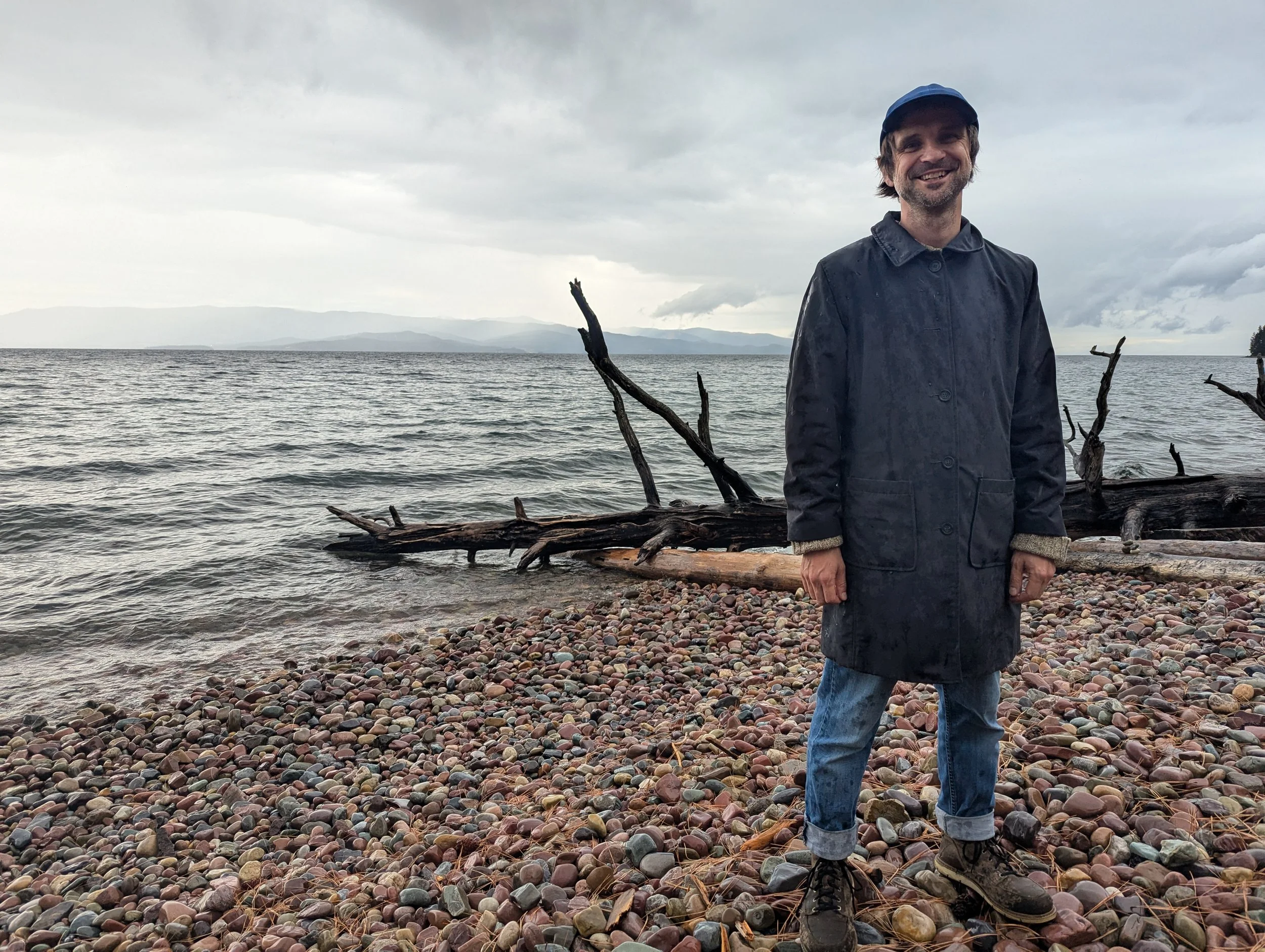
Terry Conrad at swimming beach, upon arrival at Flathead Lake Bio Station
Describe your Open AIR Residency experience. For example, how did you spend your time, construct your space, or engage with the community?
First, my month at Flathead Lake was about taking advantage of the time and location. The non-studio time was maybe more important than making things. Collecting experiences: traveling around the area to places like the Nyack Flats led by Research Specialist Phil Matson, a family drive through Glacier, and a meaningful solo trip to historical Butte, MT. I spent time reading at the rocky beach on Flathead Lake and then poking around the experiments happening by scientists and researchers at the Bio Station. On another family trip, we visited the CSKT Bison Range, a nearly 19,000-acre area on the Flathead Indian Reservation, where the Confederated Salish and Kootenai Tribes are the stewards of the bison.
Also, while in residence, supplemental to making instruments and noise makers, I was collecting recorded sounds that I called my “sound journal”. This is new to me and something I plan to continue doing. These sounds consisted of noises of the Bio Station, whether it be the water, the trees, a scientific tool, or me playing an instrument within the Flathead Lake ambient sounds. I collected hours of interesting sounds from being out on the boat while research was being conducted by Senior Research Associate Tyler Tappenbeck. There were so many other sounds to focus on at Flathead Lake Biological Station, the sounds of the Owl Research Institute researchers investigating the Northern Saw-whet Owl in the distance, the insects surrounding me, and the birds in trees.
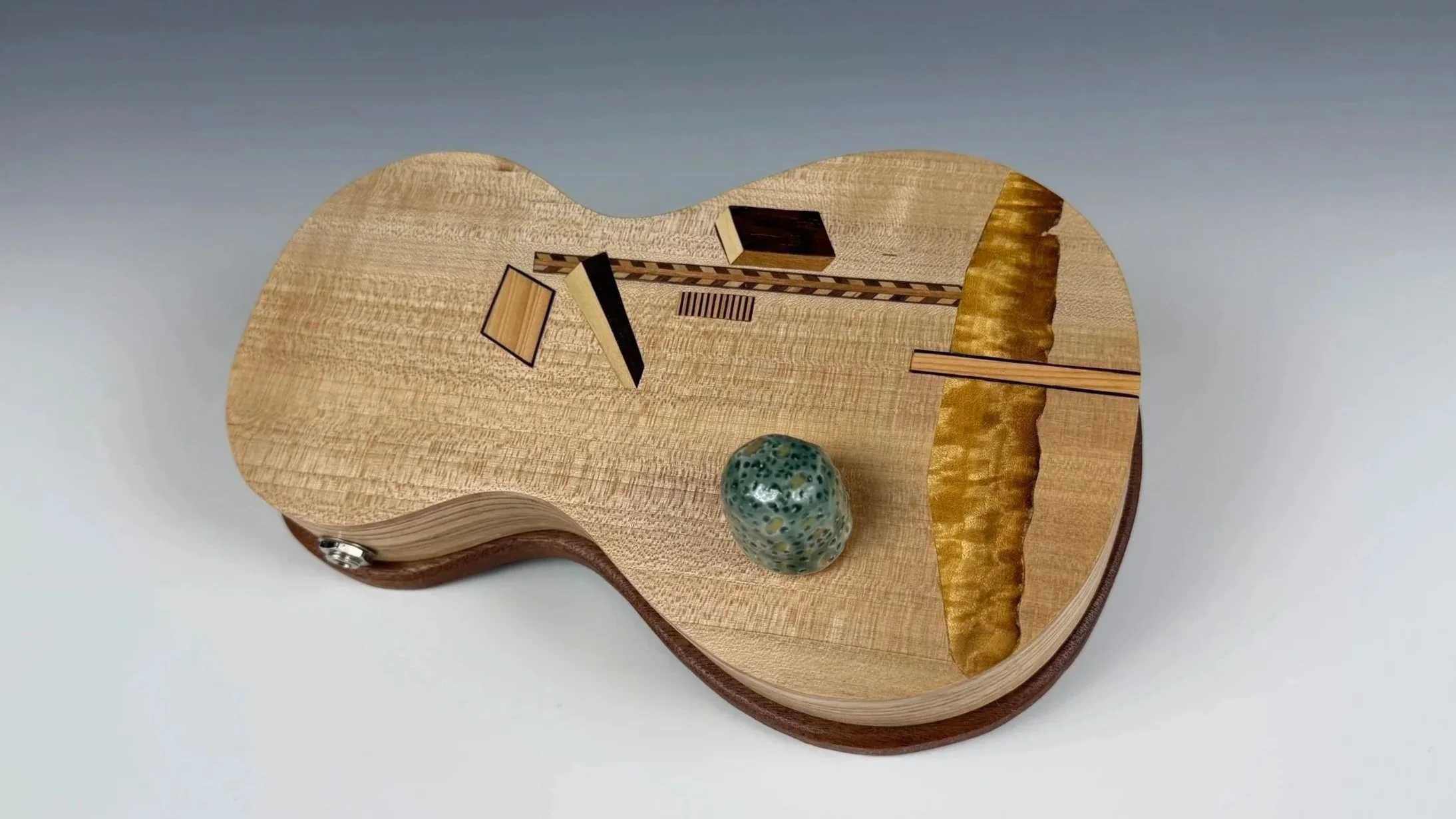
Nyack Weather Station (Tremelo), found wood, ceramics, electronics, 2026
What are you reading/watching/or listening to?
While in-residence I was reading Montana stories and authors such as The Boxcar Librarian by Brianna Labuskes, The Heart in Winter by Kevin Barry, and Beartooth by Callan Wink. After the residency, I was inspired to read more Montana stories such as Hush of the Land by my wonderful fellow FLBS Artist in Residence Eva-Maria Maggi and Sun House by Missoula author David James Duncan. My copy of Sun House was given to me by my friend artist/writer Richard Opper, whom I met while he was an Artist-in-Residence in Butte through Open Air. Eva also introduced me to the powerful writing of her friend Debra Magpie Earling. All this to say that my mind found it difficult to leave the images and stories of Montana.
I am very much interested in artists composing with sounds, noisy independent music, and folk music from a variety of cultures. Sound and music is the artform that I consume most. It’s a goal to be supportive of sound artists/musicians working independently putting out their own stuff or on smaller labels. I have been spending a lot of time with Douglas Milliken’s project The Plaster Cramp, and the sounds of a dear friend and instrument builder Brian Dewan, who resides in upstate NY. A few bands from across the globe I am very excited about are El Khat, a Yemini group residing in Germany and the Slovenian trio, Širom, both bands build some of their own musical instruments.
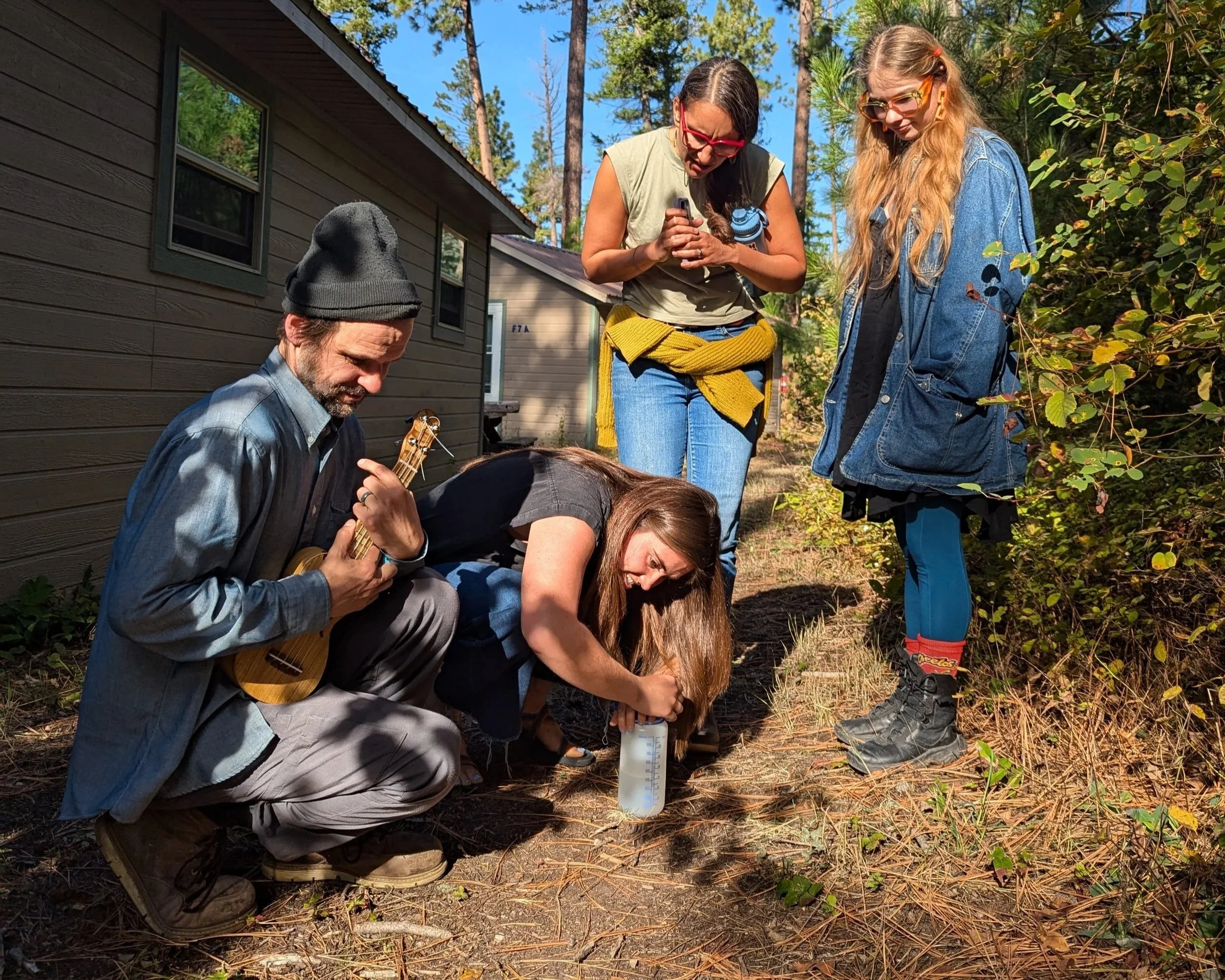
The 2026 FLBS Cohort - adventuring together (pictured from left to right: Terry Conrad, Olivia Gorham, Eva-Maria Maggi, and Annabelle Sigmond)
What role does place (both in terms of physical space and community) play in your work, especially during your time at Open AIR.
I cannot make things in a vacuum. Don’t get me wrong, I love to make things alone in a quiet, focused state, but really I need to be around people. It’s important to have my family be part of what I do. I need to get feedback from my six-year-old daughter and my partner’s thoughtful mind. They see things very different than I do, and I am always surprised when these two people who know me better than anyone can point things out about my work that I didn’t realize.
You never know how you will “click” with people at a residency, but I do thrive off of meeting people. Especially when there is a connection. I don’t think I would flourish at a residency that is secluded and requires being alone, making for long periods of time. I was lucky to meet Olivia Gorham, Annabelle Sigmond, and Eva-Maria Maggi at this residency. We were fast friends, and since the residency, we have kept in touch. We had great dinners, day trips, studio visits, and life conversations. We’ve maintained friendship since the residency and check in over Zoom here and there. We all make such different-looking work, but we connect on ideas in so many exciting ways.
Some people may want a residency with less community activity, but I love and need it. I often feel like I am at a knowledge deficit when there are so many things to learn about the natural world, and I get caught up in how to make a positive impact. Being around the scientists, asking questions, eavesdropping on them, and witnessing research is the most ideal setting to inspire my studio work. It helps that, in my regular life as a professor, I manage to get studio time daily. So, what I needed was a residency that promotes learning and the collection of information (and materials) to feed the daily studio ritual.
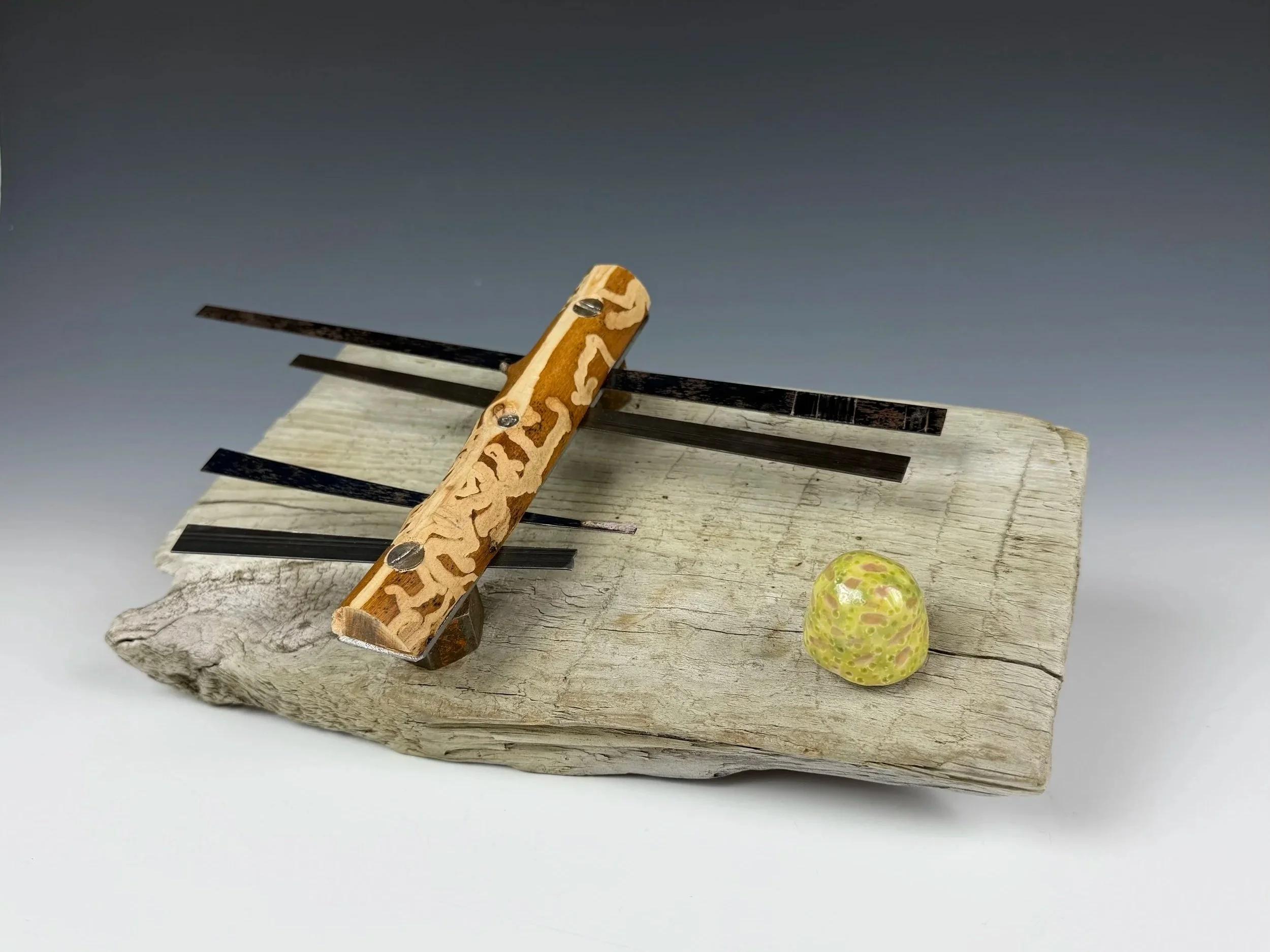
Lamellophone, Wood collected from Flathead Lake, MT, metal, electronics 2025
How have your material/process choices changed over the years?
I consider myself a printmaker, instrument-maker, and tool builder. These processes typically require specific materials. Printmakers typically work with a matrix that prints on paper with ink. I am intrigued by the idea of the trace of something, perhaps how a found object or tree relates to its “origin”. I have studied woodworking and print processes for years, but what really excites me is using these skill sets with less traditional materials or found materials. In other words, collecting found materials that have another history and retrofitting them to do another task.
At Flathead Lake, I found a lot of beautiful driftwood. I collected coarse woody debris (CWD) daily - the CWD would wash up on shore, and I would consider their beauty in tone and visual characteristics. I found pieces of old docks, wood that was partially burned in a campfire, and sometimes random pieces of plastic. Toward the end of my residency at FLBS, when the scientists saw what I was working on, Research Assistant Sydni Racki gifted me a bunch of beautiful, broken, used scientific materials that I will be using in some new objects and instruments.
Whether it is wood or detritus, I like to treat these findings as special pieces of material that have a resonance. I think I am being both literal and poetic here. Instrument builders typically use specialty woods for their sound or tone, in this case, I wanted to experiment with materials that are less precious. Maybe they gain their relevance through being constructed and developed into something new.
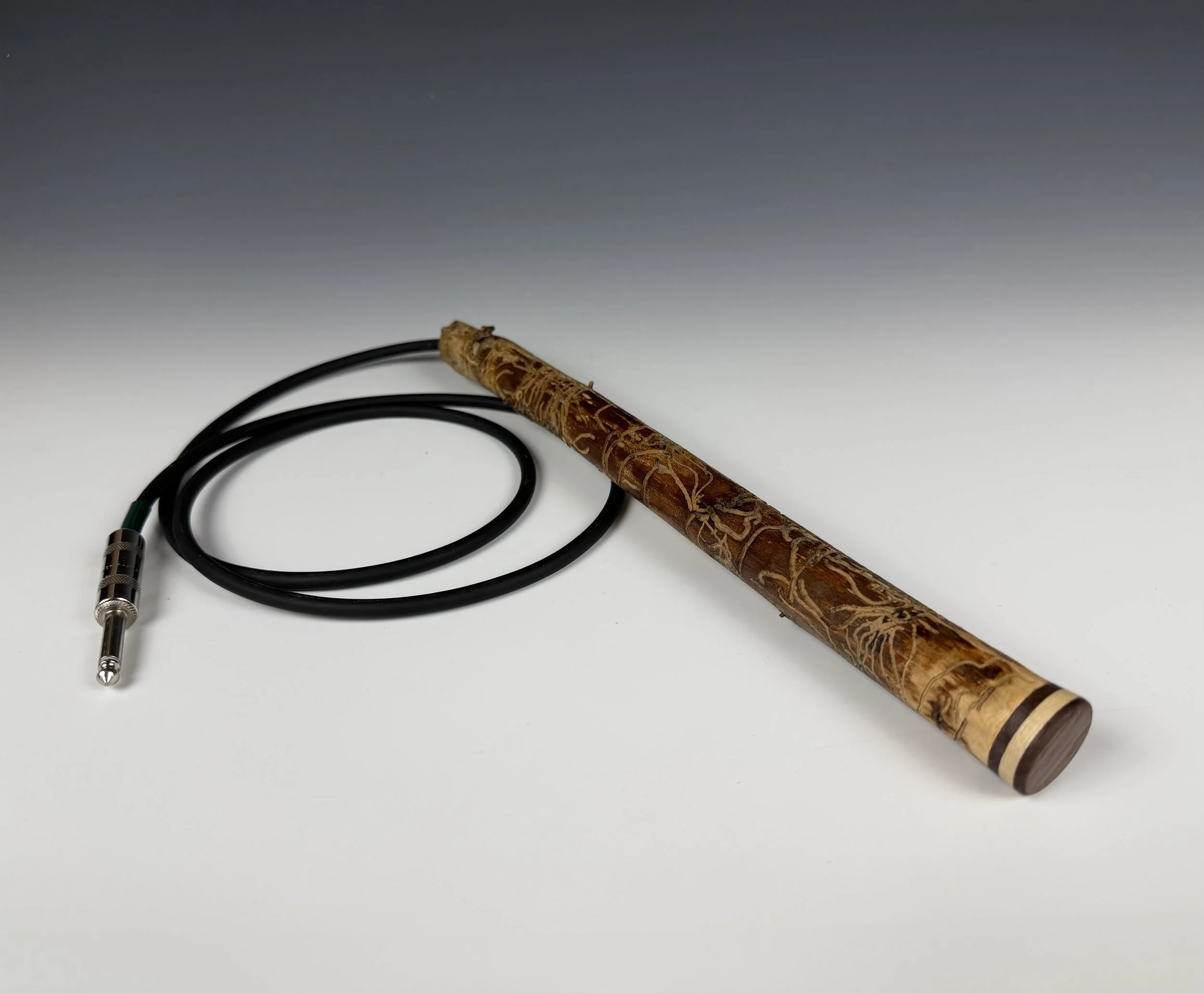
EMF Wand, Rocky Mountain Fir, electronics, 2026
Much like the prints I typically make, where I collect found materials to make the tool (matrix, press, and ink) to print with. There is an absurdity to the objects I make; these particular tools in the print process are about making a multiple in the slowest, most inefficient way possible- the opposite of industry, which is about speed and marketability.
In general, I would say that wood is a primary material in my studio. I like to think of a tree’s history, location of growth and characteristics. I exclusively use found wood, whether it be naturally felled then I mill it, or reclaimed in some way. I have so much to learn about wood and trees and their role in ecosystems.
Wherever I am, I collect materials. Sometimes I use them immediately and sometimes it takes a while. As I get older, I rush less. Sometimes I rush to use materials or take advantage of a moment such as being in a place. I want to take advantage of the location. I often now ruminate on experiences and let them develop within other experiences over time, making connections between life events, and spending years to make a project from past collections. Presently, I am excitedly sifting through collected items from Flathead Lake, whether it be a beautiful piece of Rocky Mountain Fir or broken scientific equipment from the scientific team at the Bio Station.
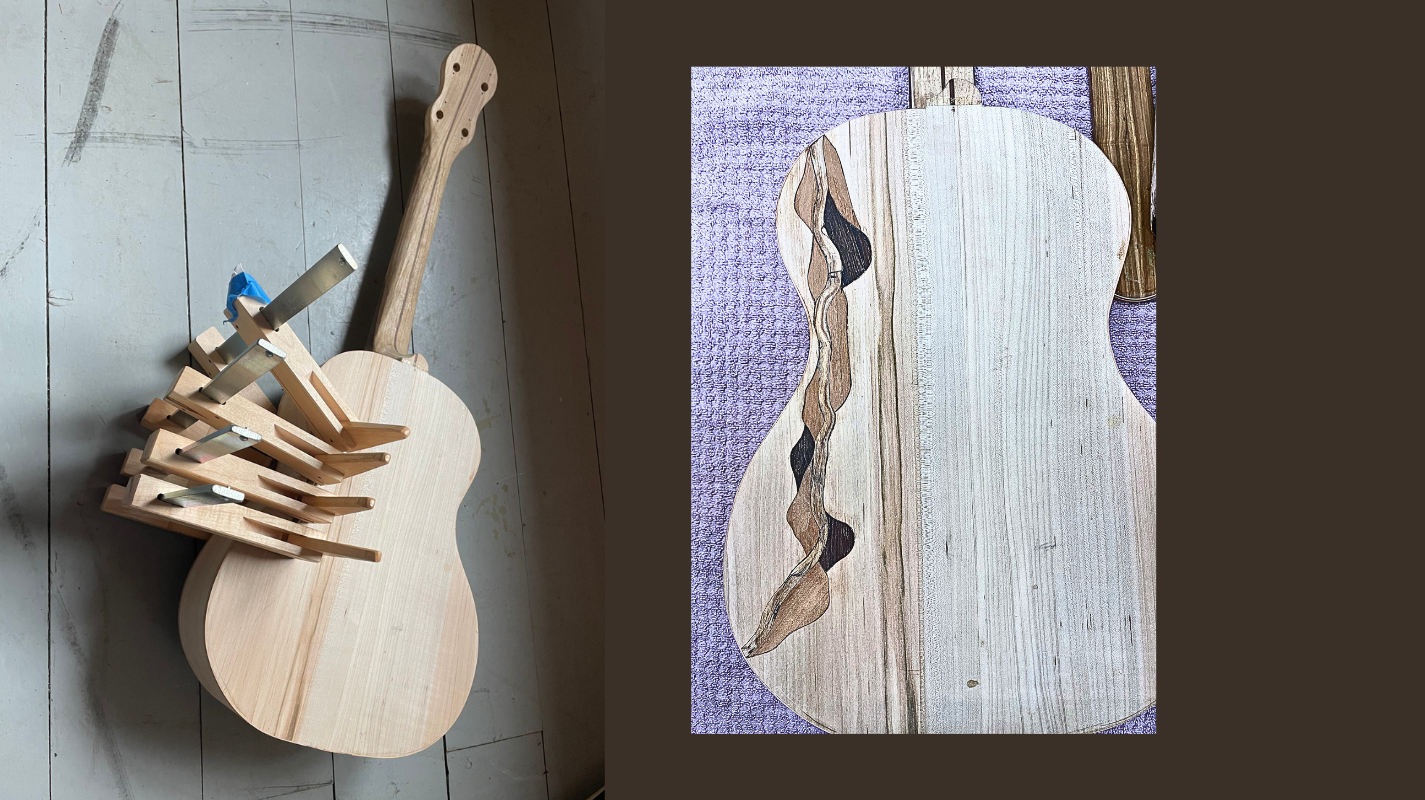
Nyack Baritone in varied stages of process
In your view, what can society do to best support artists, creatives, and a thriving creative ecosystem?
First, I want to say that there’s really nothing like Open Air, Montana. I think every state should have something like it. I find the vibe to be just right. There is a big window of expectation that Open Air provides each artist. You could go to a location in Montana and think and read or learn from the area or dig deep into studio time. The community at Open Air made me feel like any avenue is valid. Whether it is research, recalibrating or intense making, it all needs to happen. I am thankful I got to do a combination of all those things.
Different artists need different kinds of support. In my case, I needed to see the research being conducted at Flathead Lake Biological Station to inform my studio work. Some artists need financial support when doing these kinds of things because bills don’t stop when you’re on a residency. It is amazing that Open Air is able to support artists monetarily, even a little bit of money is significant in these cases.
What wisdom would you share with other artists?
Community might be at the top of the list for me in making a thriving “career”. My friends, family, and students are a major part of what I do. If I have a recommendation for artists’ it is to show up for other artists. It’s so easy to stay home. You can’t go to everything, but it’s important to support other artists with your presence. Do your best to support the community that supports you. In other words, don’t show up only for the things that you are part of.
I would also recommend trying to expand who you interact with, get to know, and share your work with other communities. Open Air is an amazing example of how art can function in society without being an exclusive art venue or community. I believe as artists it is our job to show others the things we don’t typically see. Whether it is pointing something out or sharing other worlds to new audiences.
This interview has been edited for clarity.
Visit These Links to Find Out More About
Terry James Conrad
Terry’s website
Terry’s Open AIR testimonial & beach performance
Terry’s Artist Presentation
Follow Terry