Summer 2025 Artist-in-Residence at Missoula Insectarium and Butterfly House
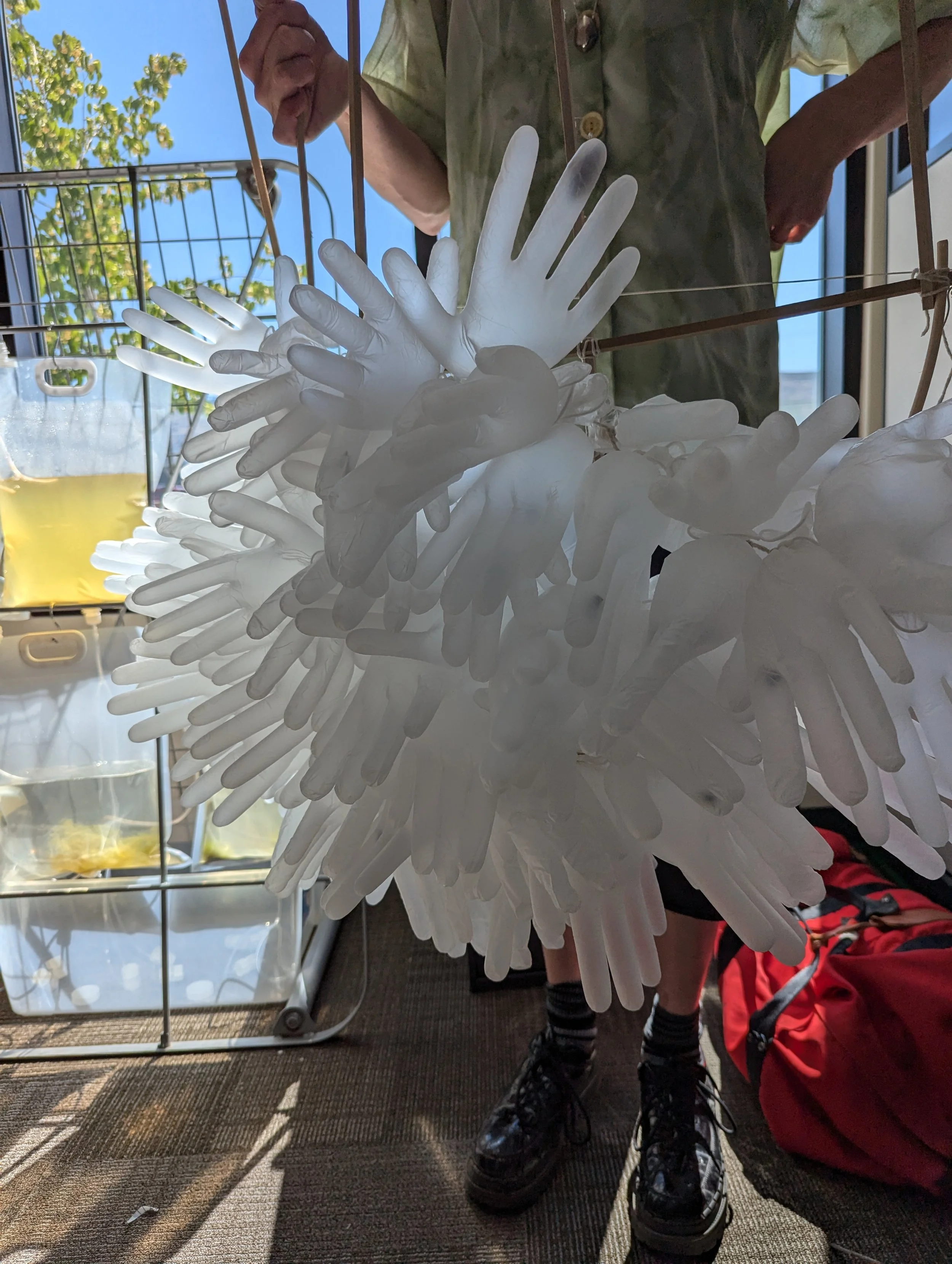
Eleanor Qull in their office space at Missoula Butterfly House and Insectarium
Describe your Open AIR Residency experience. How did you construct your space?
Between early June and the end of July I was occupying a corner window at the Missoula Insectarium and Butterfly House. It was a surprisingly big adjustment but the support for community spaces and artists in Missoula is so tangible.
The first day I moved into the corner of the Insectarium and Butterfly House offices I set up a station for growing algae. I brought air pumps, tubes, medium, and a control specimen. This involved building a frame with materials found at Home ReSource, (which had to be secure in order to not catastrophically spill bags of brackish water all over the carpeted Insectarium office), and setting up the suspended bags and air pumps. I began collecting live samples from the Clark Fork River, which has had a recent flourishing of string algae. Eventually, the circumference of exploration to find algae widened to surrounding water bodies.
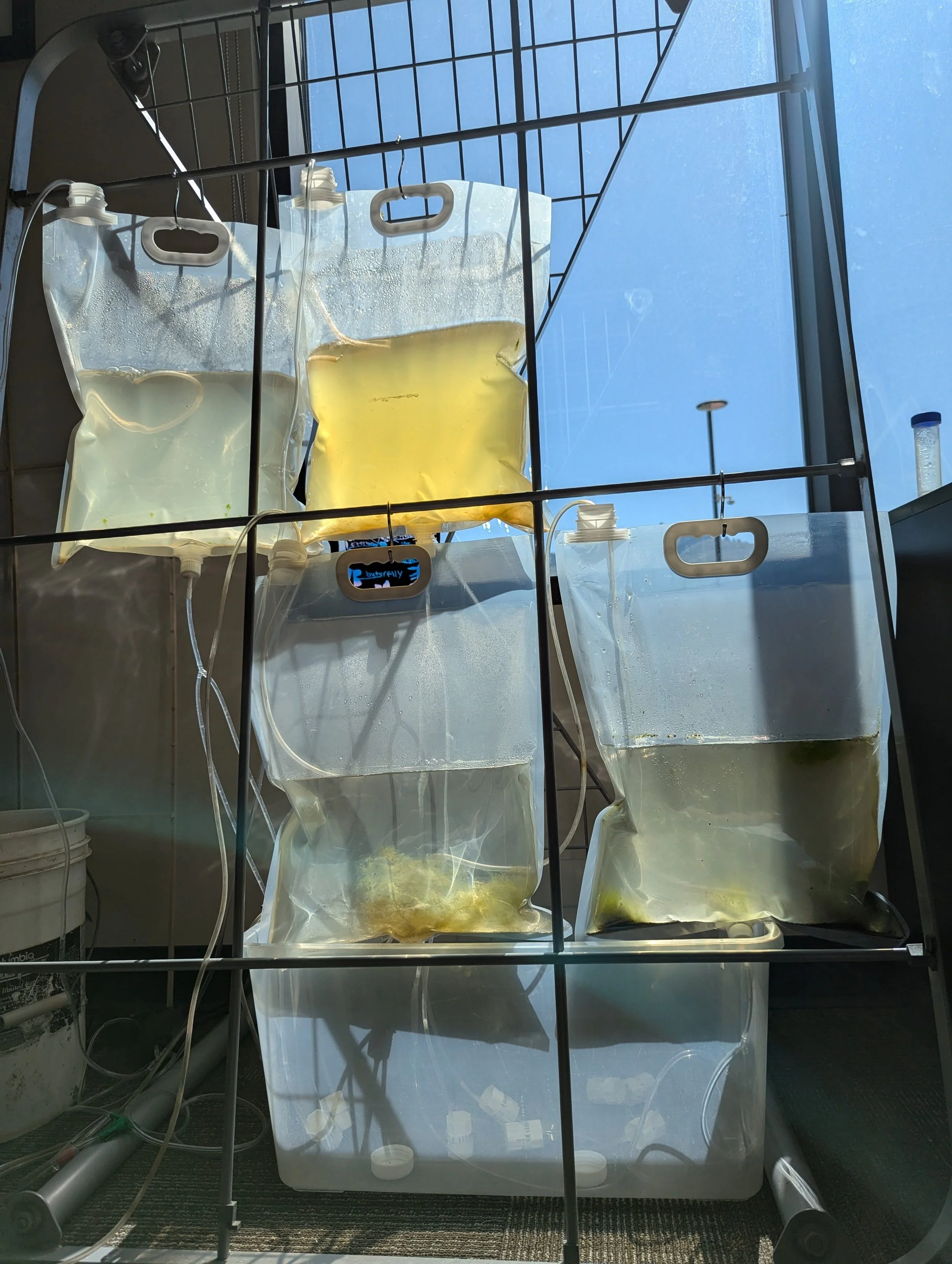
Eleanor installed air pumps, tubes, medium, & a control specimen on Day 1.
Did you establish a rhythm or new practice during the residency?
Quite soon, I established a ritual of coming into the ‘office’, plugging in and readjusting the pumps, sometimes feeding the algae, and unplugging when I left for the day. Oddly, it was a companion when I worked, as I tended to subconsciously join in verbally with the bubbling chorus. It was mostly a source of despair. One of the supposedly easiest and fastest-growing organisms struggled, and getting the chemical balance right was difficult; the cultures won out in the end. I did have some accidental ride-ons join one of the samples taken from a remote agricultural watering hole.
This practice was a kind of intention setting – to use the residency as an exploration of the interaction of air, humans, and non-humans. I didn’t get further with this part of the project other than establishing the growth, but later I will experiment with making pigments associated with different sample sights, and even creating structures from algal substrate.
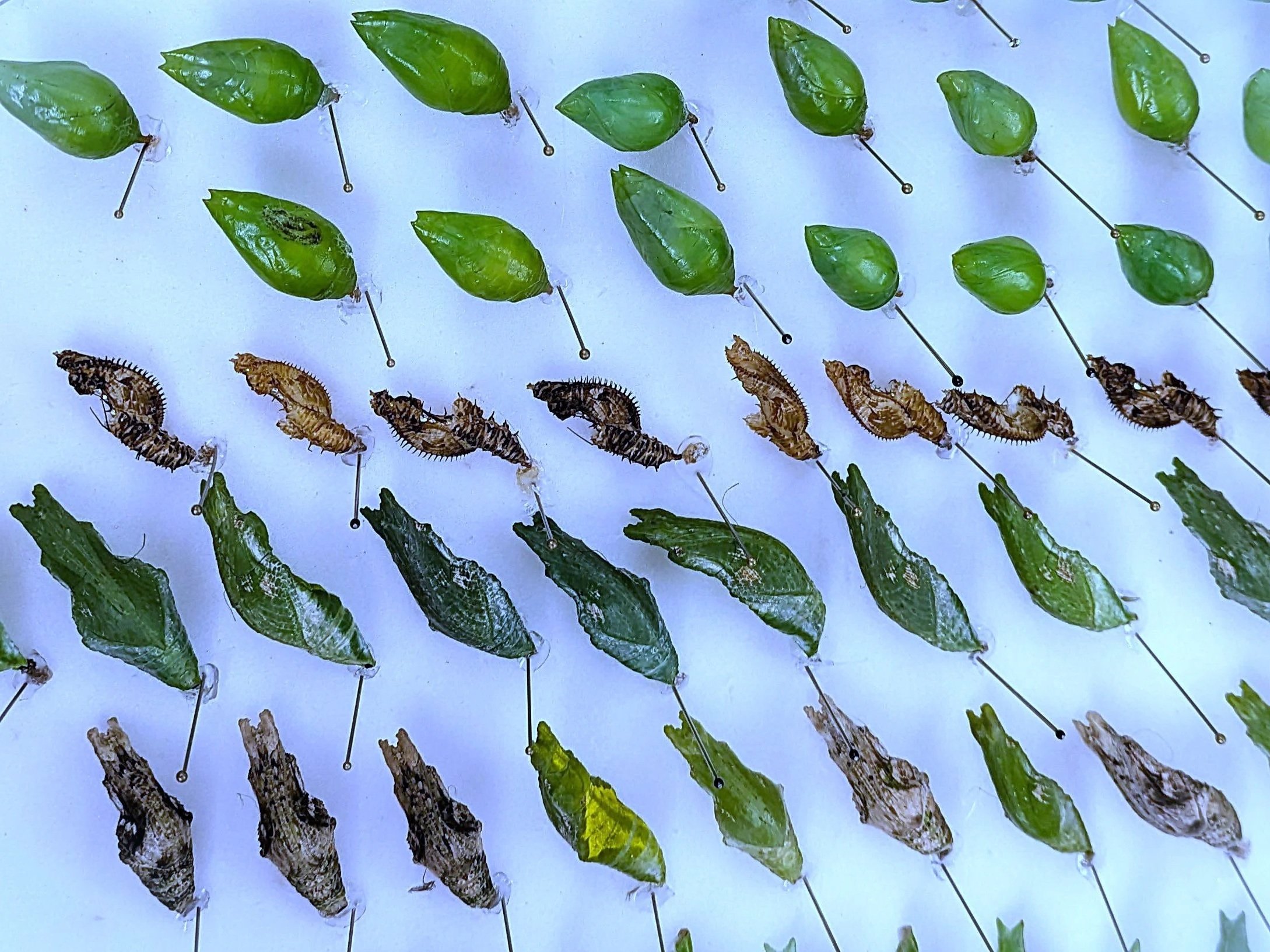
A Chrysalid Pinning
What are you reading / listening to / watching?
Something I read relatively recently that completely transformed my understanding of deep time and ecologies was Otherlands by an English palaeontologist Thomas Halliday. I’ve been preoccupied with conceptions of Deep Time, and each chapter of Otherlands occupies a vastly different specific geological time period and place. The chapters are vivid descriptions of active ecologies and non-human life, and of everything we know from the geological, fossil, and microbial record. It deeply underscored the extent to which any and all perceptions of permanency – geological, ecological, or otherwise - are temporal.
I have become fascinated by changes in the gaseous and chemical composition of the earth’s atmosphere. What caused those changes, and what vast arrays of effects have they had on systems of life? Particularly, I am interested in the birth of complex life forms as the result of floods of nutrient phosphates being released 750 – 650 million years ago into the ocean and causing a flourishing of eukaryotic cyanobacterium – a rise of algae and production of oxygen that shifted the bacterial-dominated world to more complex ecosystem. Given the current rapidity of change in the composition of the atmosphere and our place as human designers of that change, however accidentally or tangentially to more immediate intentions, I’m fascinated by the interaction of air – human – and non-human beings, particularly within the context of the spectacular and unimagined extent of insect/ arthropod ‘technologies’.
There is so much that has been discovered about insects, arthropods, moths, bees, and butterflies that seems invented – I would recommend Steve Nicholl’s book Alien Worlds about insect evolution and biology.
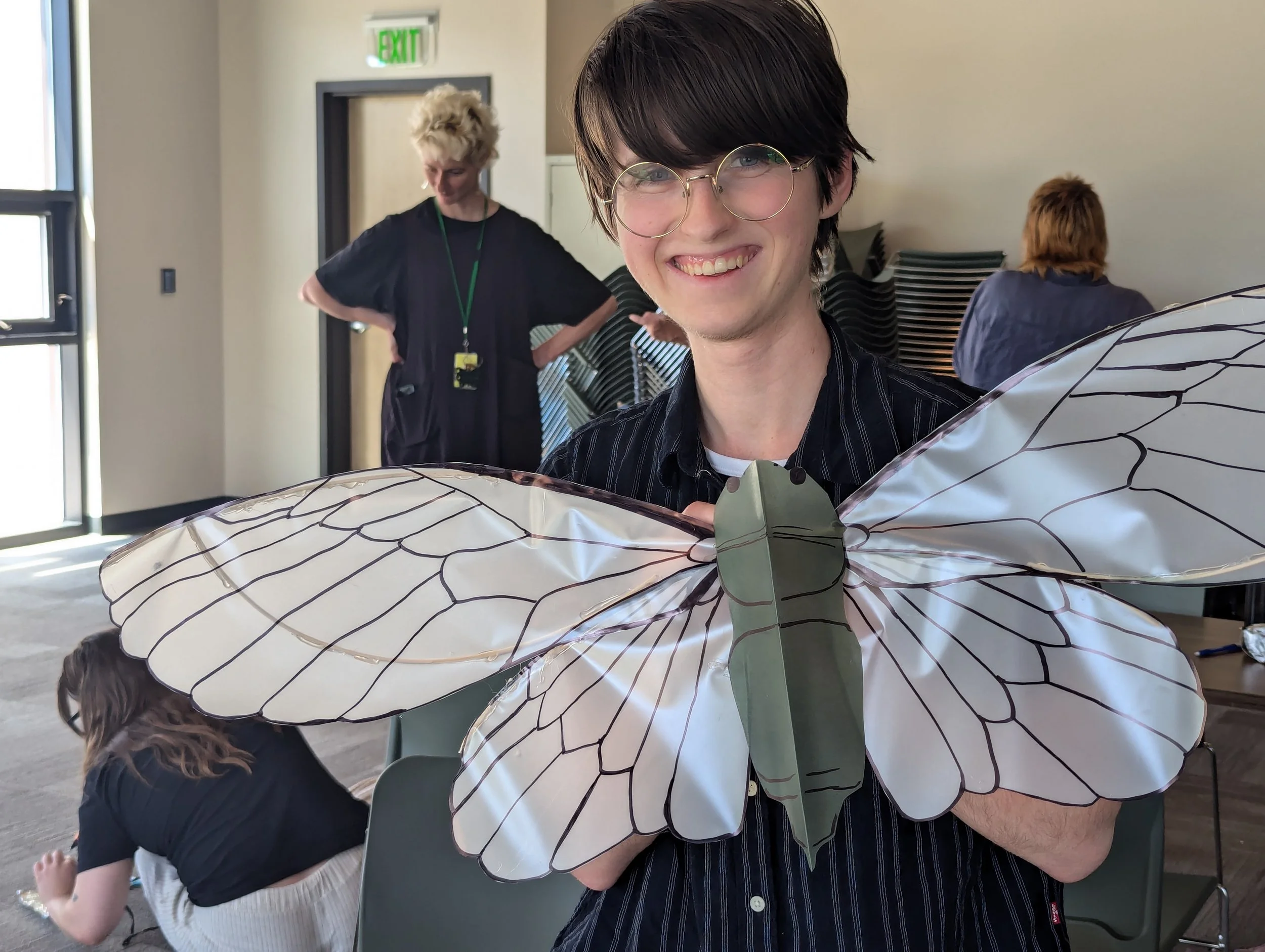
A creation that came out of the kite-informed workshop led by Eleanor.
Can you share how the residency connected to your ongoing practice or opened new avenues for exploration?
The residency became an exploration of contemporary and potential future ‘creative’ conceptions of pulmonary space, set within new imagined hierarchies that prioritize insects as ecological kin, and understanding insect ecologies. I was trying to produce new ways we can be creative about that and interact consciously and creatively with the chemical compositions around us by making a series of test ‘air instruments’ (kite informed sound organs) that are specifically influenced by what I had learned about insects throughout the residency.
It was a series of creative experiments in how to create alliances with other conceptions of kin – insects, algae, air, toxic molecules - in the face of the necessity (by dint of catastrophic fires in the west and other places, and future unknown atmospheric catastrophes) for new ideas for how we interact with our environments.
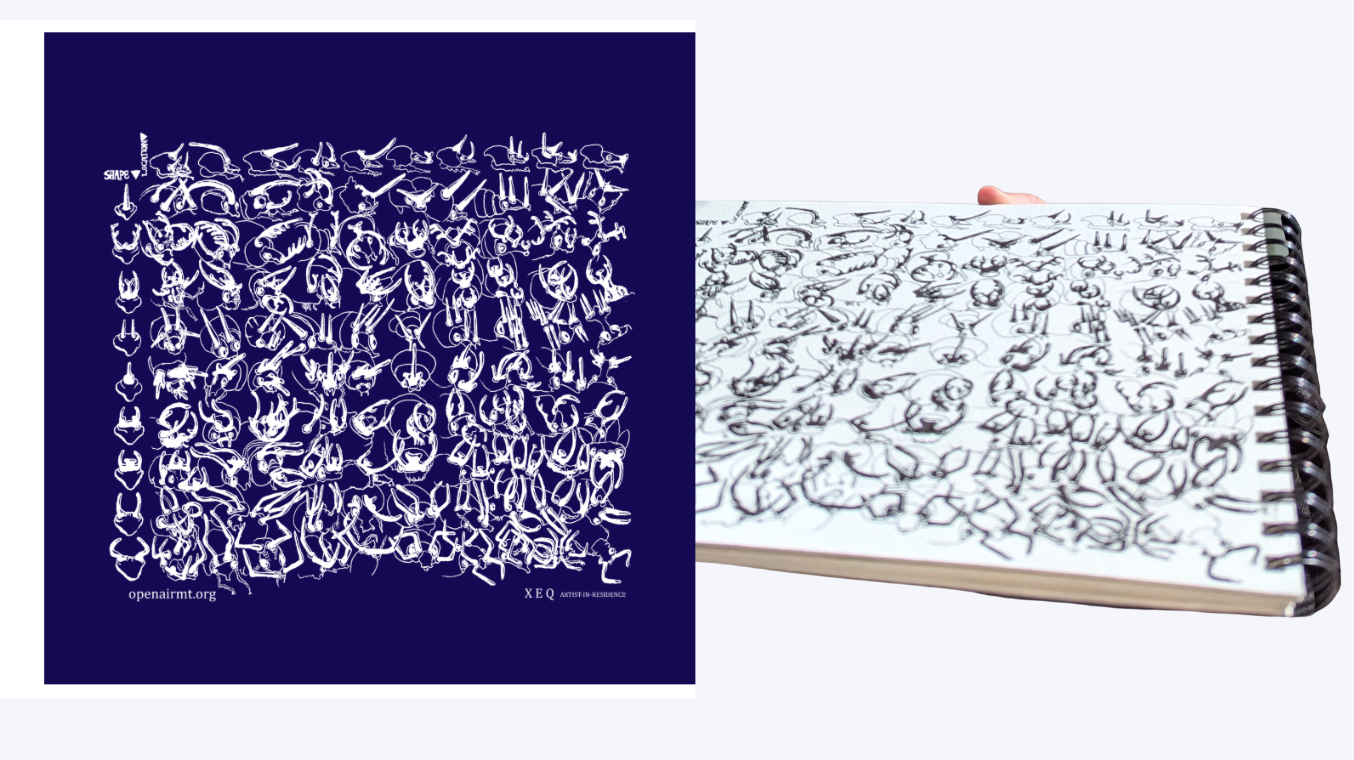
Eleanor’s insect inspired-drawings became Open AIR bandana swag!
How did your residency work with community?
All of my work emerges from interactions with people, place, and exposure to new ideas and frames of knowledge. The folks at the Insectarium and Butterfly house (and of Open Air) were incredibly generous, allowing me full access to their spaces, their processes, books, and their spectacular range of knowledge. All of the residency was deeply informed by what they shared, their insights, and by spending long amounts of time in the butterfly house at all times of day, volunteering to unpack and pin chrysalids, going to the daily predator feeding whenever I was available.
I was also so inspired by what attendees to the ‘kite making’ workshop created – their creative imagining of the future, their experiences and understanding of insect and how they engaged with the workshop challenges.
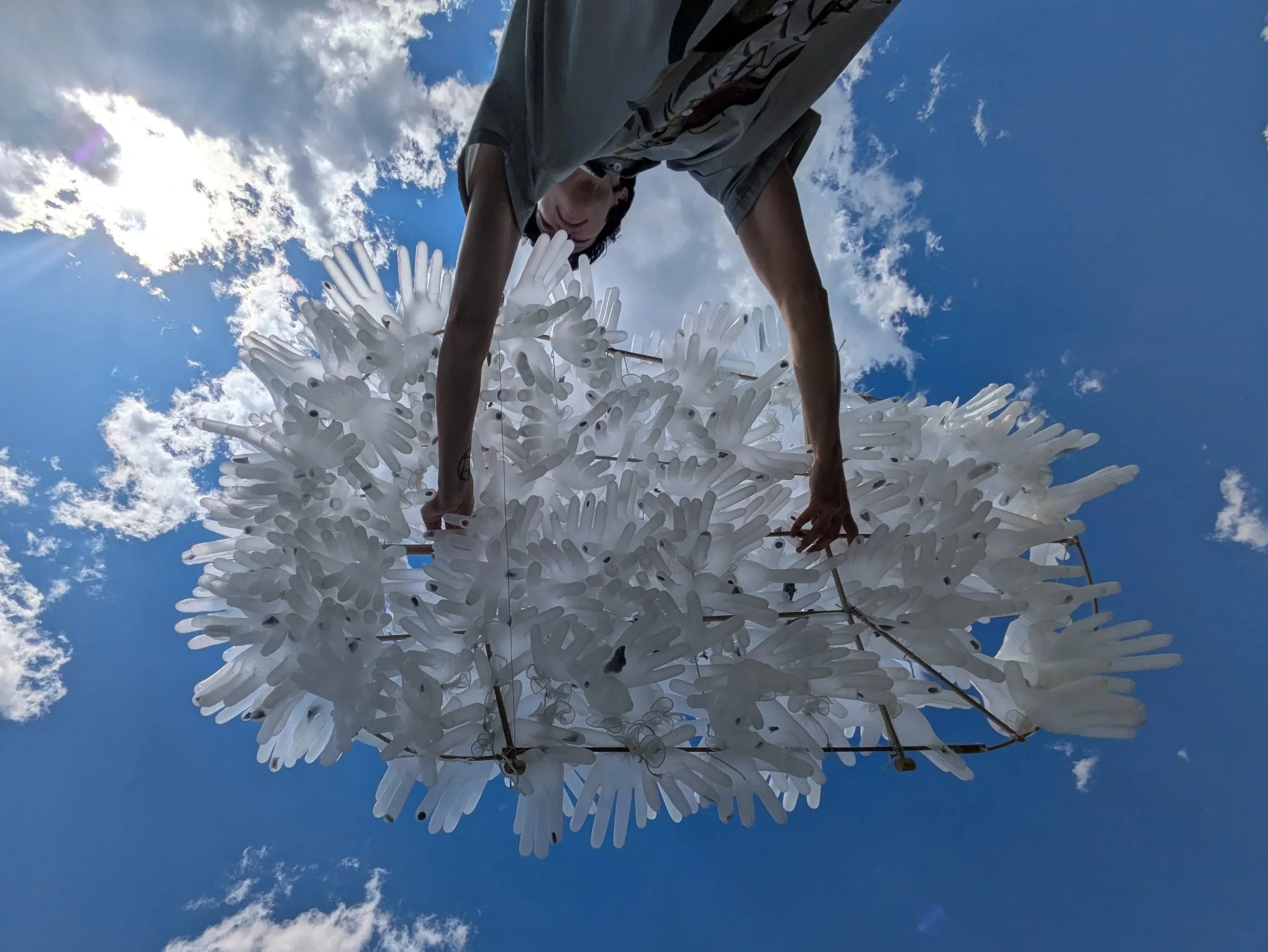
Eleanor experimenting with kite-influenced inspirations, outside.
What were some of the challenges of the residency?
A major challenge was being grounded in Missoula. We all have psychogeographic maps of the places we live, which includes access to support and social networks, tools, resources, and materials. There were limitations of time and space – of finding those resources, for example, a wood shop with certain machines and materials that I would typically use – and accepting what I already had gathered and the limitations of time. In the end, it was necessary to give up my predetermined expectations of what I could or would accomplish and to set things aside for the future. This was a significant psychological hurdle - I so rarely, anymore, share anything that is not absolutely complete.
Another major challenge was my discomfort with being the face of my art when I always prefer the art to be its own face, or have an associated invented face, subject to the interpretations of others. This was such a process-focused residency. My process is, if anything, secretive, and I have rarely shared the specifics of my background, artistic development or identity. Identity as an artist is something that changes for me, rapidly transforming over time in response to the force of ideas – or an exploration of vastly different aspects of my identity or inclinations in every project. Like in the theater, like the public facing understanding of many of us as a series of exaggerated silhouettes. In my process, the ‘artist’ or ‘creator’ is as much a creative construction as the art itself, the creation of which is deeply intertwined in the process – and attempts to replicate the complexity of systems of information, material exchange, and environments we live with. This is not at all a commercially viable model of practicing art.
This interview has been edited for brevity.
Visit These Links to
Find Out More About
Eleanor Qull
Visit Eleanor’s website
Follow Eleanor on Instagram
Eleanor’s Artist Presentation